Most people can name the purifier running in their bedroom and cannot tell you the month the filter went in. That gap is the whole problem. A purifier with a loaded filter is a fan pushing air through a clogged restriction, and the room quietly drifts back toward whatever the outdoor air is doing. If you want a HEPA air purifier filter schedule that survives a real year, you have to plan two purchases instead of one: the machine, and the filters that machine will eat.
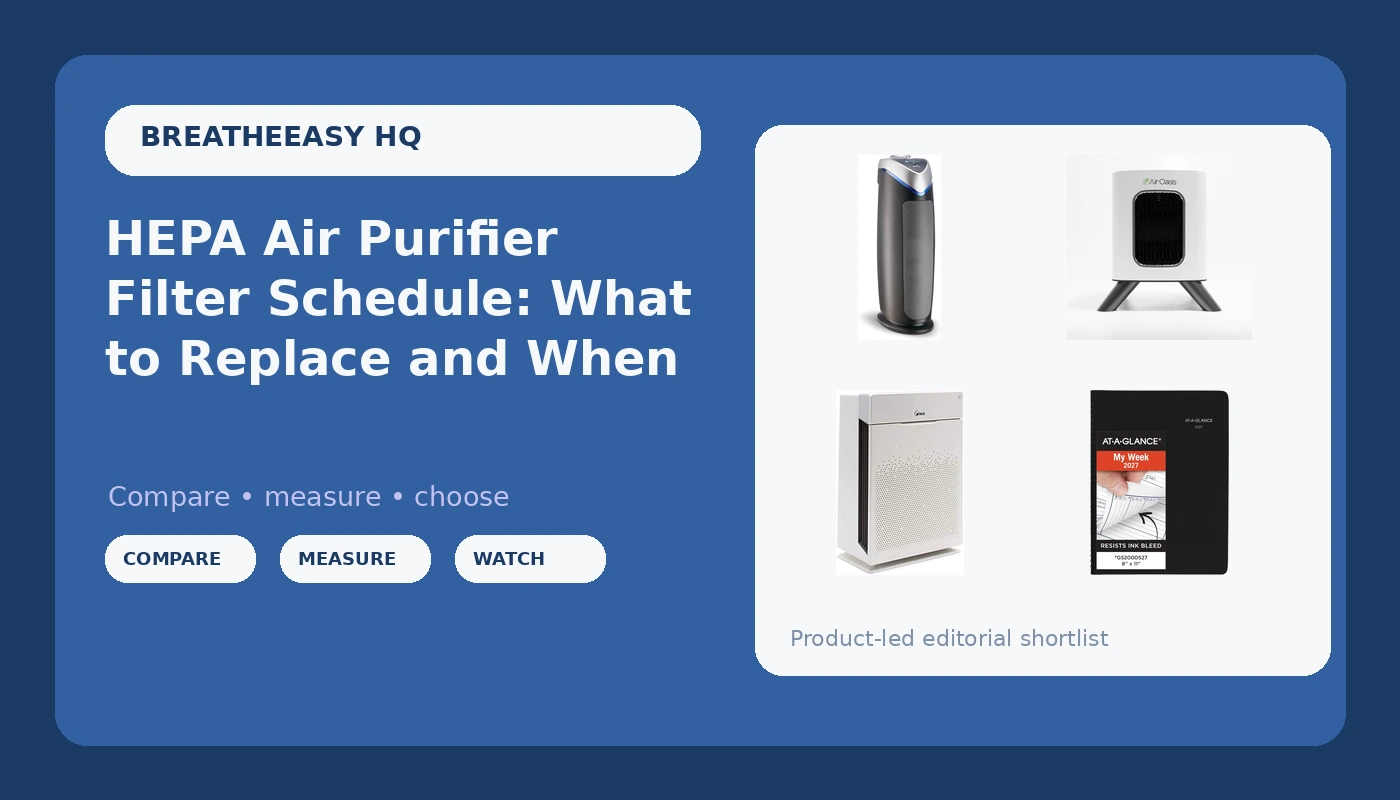
This is an explainer, not a ranked list. Three of the four items below are purifiers aimed at three different jobs: an entry-level tower for bedrooms and dorms, a large-room unit built for volume, and a five-stage model sold for pet households. The fourth is a paper planner, which looks out of place until you remember that filter changes are a maintenance habit, and habits need somewhere to live. The short version: match the unit to the room you actually have, then price the replacement filter before you commit to the machine.
Related: CADR Explained: The One Number That Predicts Air Purifier Performance →
Quick answer
Buy for the room you actually have, then budget the filter. A purifier is sized by CADR, the clean air delivery rate, which is the cubic feet per minute of filtered air the unit moves at a given fan speed. The language on a retail page ("large room," "99% of viruses") is not a substitute for that number. If your room is small and your budget is tight, a simple HEPA tower is the honest starting point. If you are trying to clean an open floor plan, you need a unit the manufacturer rates for that volume, which usually means spending more and replacing a more expensive filter. Whatever you buy, write the install date down, because the filter is the part that decides whether the machine keeps doing anything.
Four useful options
| Model | Best fit | What stands out |
|---|---|---|
| GermGuardian HEPA Air Purifier (AC4825E) | Bedrooms, dorms, offices | HEPA filtration aimed at pet dander, dust, pollen, smoke, and scents, in a 22-inch tower |
| Air Oasis iAdaptAir 2.0 | Large open rooms | H13 HEPA, WiFi compatibility, and a manufacturer coverage rating of 1,325 sq ft |
| Winix HR900 | Homes with pets, up to 300 sq ft | Five-stage True HEPA filtration |
| AT-A-GLANCE 2027 Appointment Book Planner | Tracking filter changes | Weekly, quarter-hourly layout dated for 2027 |
The entry-level tower: GermGuardian HEPA Air Purifier
Towers in this class are the units I end up discussing most with renters and dorm parents, because the footprint is small and the cost of entry is low. The catch is the word "large" in the product name. A 22-inch tower can be exactly right for a bedroom and badly undersized for a 400 square foot living room, and nothing on the box tells you which situation you bought into. The number that answers the question is CADR at the speed you will actually run, usually medium, not the turbo setting nobody leaves on overnight. Pull the manufacturer's spec sheet before you buy, and pull the replacement filter price at the same time. On inexpensive towers the filter can cost a meaningful fraction of the machine every year, and that annual number is the real price of ownership.
The large-room option: Air Oasis iAdaptAir 2.0
H13 is a filter classification rather than a marketing word. It sits at the top of the HEPA range, meaning the media is rated to capture a very high percentage of particles at the size that is hardest to catch. That matters in a big room because you need good media and enough airflow at the same time. A great filter behind a weak fan just means clean air in one corner of the space. The 1,325 square foot figure comes from the manufacturer and describes coverage under favorable conditions, so treat it as a ceiling rather than a promise, especially if your ceiling is high or your kitchen opens into the living room.
The listing also claims reduction of 99% of viruses, mold, dust, smoke, pollen, and odors, and makes a noise claim that only decibel readings at each speed can settle. Percentage reductions are measured in a chamber under controlled conditions, and "quiet" without a decibel number is a feeling, not a spec. If a unit is genuinely quiet on its highest setting, it is not moving much air. That is physics, not brand loyalty. WiFi is genuinely useful for checking a unit in another room, but if the app is the only way to switch the machine on, that is a failure mode waiting for a router hiccup.
The pet-household pick: Winix HR900
Pet households have a specific failure pattern. Hair and dander load the first stage quickly, airflow drops, and the owner keeps running the machine because it still sounds like it is working. The point of a multi-stage design is to spread that load across stages so the HEPA media is not doing the job of a shop vacuum. That makes the prefilter, whatever form it takes on your unit, the part you touch most often. It also means the 300 square foot rating describes a single room, not a floor. If you have two cats, a dog, and an open staircase, one HR900 in the living room is a start, not a solution.
The maintenance log: AT-A-GLANCE 2027 Appointment Book Planner
Filters do not fail loudly. They fail gradually, which is why so many people replace one a year late and blame the machine. A paper log survives app updates, dead batteries, and the two week stretch where you stop reading notifications. Write four things on the day you install a filter: the install date, the filter part number, the next change date, and where you bought it. Tape the receipt inside the back cover if you want the warranty paperwork in one place. When you own three purifiers, which is what happens the first time you buy one for a bedroom and a second for the living room, a single dated log beats three separate reminder apps.
Prices and availability may change. Product images, names, and retailer links must be matched by verified ASIN. Do not state a current price, rating, stock status, or measured result without current evidence.
Why CADR and filter cost decide everything
CADR is the only number on a purifier spec sheet that predicts what happens in your room. It is expressed in cubic feet per minute of clean air, and it is measured for smoke, dust, and pollen separately. A high CADR on smoke tells you the unit can move and clean a lot of air; a low CADR on smoke with a high number on dust tells you the media and airflow are tuned differently than you assumed. Retail pages rarely lead with this number, because "captures 99.97% of particles" sounds better and commits to nothing. A filter can be excellent while the machine around it is weak, and the reason is usually bypass: air finding the gaps around the filter instead of going through it. That is a seal problem, not a filter problem.
The second number nobody prints is the annual filter cost. A purifier is a subscription with a motor attached. Before you buy, find the replacement filter for the exact model, note the price, and note the interval the manufacturer recommends. Multiply. If that yearly figure approaches the cost of the machine itself, you are not buying a purifier, you are buying a filter holder with a fan. Filter cost is also the reason a cheap unit in a big room is a bad deal twice: once at purchase, and again every year when you replace media that never had a chance.
How long a HEPA filter actually lasts
There is no universal answer, because filter life is a function of particulate load, not the calendar. A bedroom with the windows closed and no pets is a gentle assignment. A kitchen-adjacent living room with two shedding animals, a smoker on the porch, and a wildfire smoke season is a hard one. Media that is dark gray, matted, or visibly coated is done, regardless of what a change indicator says. Those indicators are usually timers, and a timer does not know that you ran the unit on high for six weeks straight during August.
Carbon is the other half of the story. If you bought a purifier for odors, the carbon stage saturates long before the HEPA media does, which is why a unit that used to kill cooking smells stops doing it while still moving plenty of air. Plan on carbon more often than HEPA in a kitchen or a house with pets. And clean whatever prefilter you have on the schedule the manual gives, because a clogged first stage starves everything behind it.
- Measure the room, including ceiling height, and decide which single room you most want cleaned.
- Get the CADR at medium speed from the manufacturer's spec sheet, not from a retail bullet list.
- Price the replacement filter and the recommended interval, then multiply for the annual cost.
- Check the seal: run the unit on high and feel around the filter gasket for escaping air.
- Write the install date on the filter frame and in a log, then set the next change date.
Practical guidance for the first year
- Run the unit on medium or high when you are out of the room. Low speed overnight is a comfort setting, not a cleaning strategy.
- Clean or rinse the prefilter on schedule. It is the cheapest maintenance you will ever do.
- Keep the intake a few inches off the wall and away from curtains, beds, and shelving.
- During smoke events, close the windows and run the purifier in the room you occupy, not in a hallway.
- Buy one spare filter with the machine so a replacement is never a week of shipping away.
Which option should you choose?
Choose the GermGuardian HEPA Air Purifier when you need an entry-level tower for a bedroom, dorm, or office and you want filtration without extra complexity. Choose the Air Oasis iAdaptAir 2.0 when the space is large and open, and you want H13 media plus WiFi control and a coverage rating built for volume. Choose the Winix HR900 when the household has pets and the room you are cleaning is around 300 square feet or smaller. Choose the AT-A-GLANCE 2027 Appointment Book Planner when the real problem is that nobody in the house remembers when the last filter went in.
None of these listings gives you a verified CADR figure in this article, and that number is what actually sizes a purifier to a room. Pull the manufacturer's spec sheet for whichever unit you are considering, confirm the CADR at the speed you will run, and confirm the replacement filter price for that exact model. If a spec sheet will not state CADR, that silence is your answer.
The bottom line
Sizing comes first, filtration quality comes second, and the filter bill comes every year whether you planned for it or not. A tower like the GermGuardian is a reasonable first purifier for a bedroom or dorm. A large-room unit like the Air Oasis iAdaptAir 2.0 is what an open floor plan actually requires. The Winix HR900 is aimed at the pet household, with the multi-stage design that load demands. And the planner is the least glamorous item here and possibly the most useful, because a filter schedule you wrote down is the only one that gets followed. Match the machine to the room, budget the media, log the dates.